The dark spots arrived quietly, and then all at once.
I’ve shared this story before, but the short version: when COVID moved my work home, my skincare routine dissolved — and I had just turned 50. My desk faced a bright window, which I loved. What I didn’t know was that UVA rays pass straight through window glass, and my bare, sunscreen-less face was getting a gentle dose of sun damage every working day. A year later, I finally looked closely in the mirror: a constellation of brown spots across my cheeks that I’d never had before.
If you’re reading this with your own constellation, let me save you weeks of confusing research. After a lot of dermatologist YouTube, a lot of reading, and a lot of guidance from my daughter (my personal K-beauty encyclopedia), here is what actually helps fade dark spots after 40, arranged into a simple routine — the gentle Korean way, not the burn-it-off way.
Why Dark Spots Multiply After 40
Dark spots — the kind we’re discussing are often called sun spots or age spots — are essentially your skin’s memory of sun exposure. Melanin-producing cells, triggered by decades of UV light, start overproducing pigment in concentrated patches. Three things make midlife the moment they surface:
The debt comes due. Sun damage is cumulative and delayed. The spots appearing now were “ordered” years ago — every beach summer, every commute, every bright window. After 40, skin’s slower cell turnover means pigment that once faded on its own now lingers.
Hormones join in. Shifting estrogen levels around perimenopause and menopause can make pigment cells more reactive. Some women develop melasma — larger, symmetrical patches often on the cheeks or upper lip — which is hormone-linked and behaves differently from ordinary sun spots. (If your patches are large, symmetrical, and shift with heat or hormones, read my guide on telling age spots, melasma, and sun damage apart — melasma especially deserves a dermatologist’s eye, because the wrong treatment can make it darker.)
Slower renewal. Younger skin replaces itself roughly monthly; midlife skin takes noticeably longer. Whatever pigment is deposited stays visible longer.
Understanding this changed my expectations: fading spots after 40 is absolutely possible, but it’s a months-long project, not a two-week miracle. Anyone promising faster is selling something.
The Korean Approach: Brighten Gently, Protect Fiercely
Western spot treatment often leads with intensity — strong peels, aggressive lasers, prescription bleaching. Those have their place (and for stubborn spots, a dermatologist is genuinely your best investment). But the Korean philosophy, refined over decades in a culture where luminous, even-toned skin is the ideal, rests on two humbler pillars:
Brighten gently, daily. Korean “brightening” (미백) products favor ingredients that calm overactive pigment production over time — niacinamide, vitamin C, alpha arbutin, rice extract — at tolerable concentrations you can use every day for months without wrecking your skin barrier. Remember, midlife skin barriers are already more fragile; an irritated barrier actually triggers more pigment. Gentle isn’t just pleasant — for spots, gentle is strategy.
Protect fiercely, daily. Every unprotected sun exposure re-darkens the spots you’re trying to fade. Sunscreen isn’t step five of this routine; it’s the foundation the whole project stands on. Fading spots without daily sunscreen is bailing a boat while drilling holes in it.
The Routine, Step by Step
Morning — defend and brighten:
1. Rinse or gentle cleanse. Nothing stripping; a compromised barrier makes pigment worse.
2. Vitamin C serum — and here the order depends on your form. If you use a pure L-ascorbic acid serum, apply it now, on bare, dry skin before your toner, and wait about a minute: pure vitamin C needs a low pH to absorb, and bare-skin application preserves it (damp skin and a neutral toner underneath can dilute it and nudge the effect down). If you use a gentle derivative — which for midlife skin is often the smarter, less irritating choice, more below — the pH rule barely applies, so you can just as easily apply it after the toner in step 3. Either way, vitamin C brightens overall tone, softens existing spots, and adds an antioxidant layer under your sunscreen.
3. Hydrating toner, patted on damp skin. (If you’re using a gentle-derivative vitamin C, this is a fine spot to apply that serum instead — right after the toner.)
4. Moisturizer.
5. Sunscreen, SPF 50, every single morning, indoors too if you sit near windows. Learn from my home-office window. This step alone — nothing else — will prevent most future spots and stop current ones from deepening.
Evening — repair and renew:
1. Gentle cleanse (one cleanser is enough on a normal day; double cleanse only after heavy makeup or thick sunscreen).
2. Hydrating toner.
3. Niacinamide serum. The quiet hero: it interrupts pigment being handed up to the skin’s surface, calms redness, and midlife skin tolerates it beautifully. Vitamin C in the morning, niacinamide at night is a classic, gentle brightening pairing. (Wondering whether to choose one or use both? I’ve written a full comparison.)
4. Two or three nights a week: gentle renewal. A low-strength retinol or a mild exfoliating toner (PHA or lactic acid) speeds up the turnover that carries pigmented cells away. Choose one, not both, and never on the same night. If you’re already using retinol for wrinkles from my neck-care routine, that counts — no need to double up.
5. Moisturizer or night cream to seal everything in.
That’s it. No twelve products, no burning sensations — just the same short ritual, repeated until the mirror starts agreeing with you.
My Product Picks: 3 Brightening Serums Worth Starting With
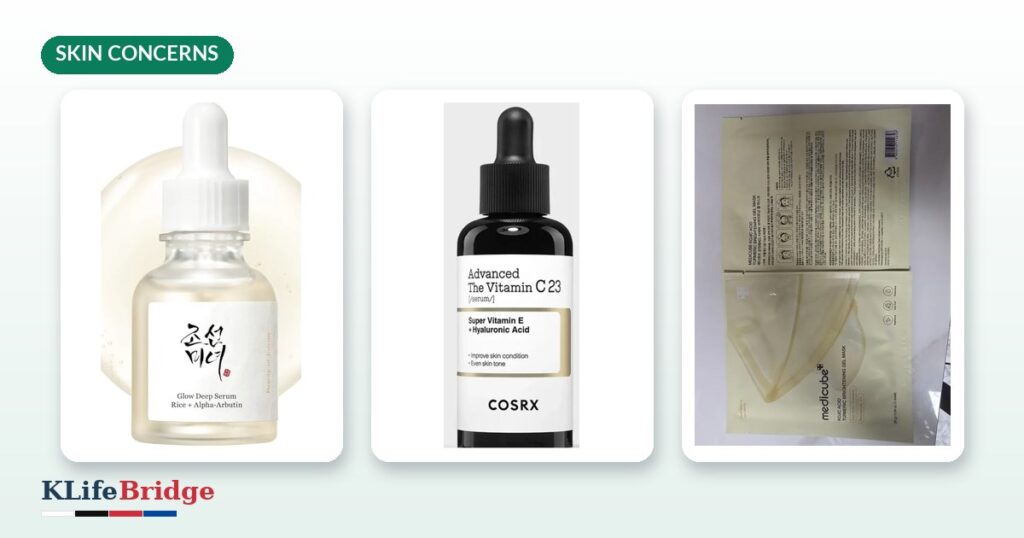
These are the three my daughter and I would put in a beginner’s basket — chosen because they match the ingredients above, suit sensitive midlife skin, are affordable ($ 17-$27), and are among the most-reviewed and best-loved K-beauty brightening products internationally. I have no sponsorships and earn nothing from these mentions — this is simply where I’d tell a friend to start.
1. Beauty of Joseon — Glow Deep Serum (Rice + Alpha Arbutin) ·
The cult favorite for dark spots. Alpha arbutin targets pigment directly while rice bran water — a Korean beauty tradition centuries old — softens and brightens. Feather-light, layers under anything, extremely gentle. If you buy one product from this article, this is the one.
2. COSRX — The Vitamin C 23 Serum ·
A serious but well-buffered pure vitamin C for your morning step. Noticeable glow within weeks; keep it refrigerated and use it within a few months (vitamin C oxidizes). If your skin is very sensitive, start every other morning — or choose a gentler vitamin C derivative serum instead.
3. Numbuzin — No.5 Vitamin-Niacinamide Concentrated Serum ·
The evening niacinamide workhorse, beloved for visibly evening out tone and adding that “glass skin” luminosity K-beauty is famous for. Pleasant texture, plays well with retinol nights.
Prices are approximate US prices at the time of writing. All three are easy to find at Amazon, YesStyle, Olive Young Global, or Soko Glam.
What to Expect (Honest Timeline)
Weeks 1–4: better glow and hydration, spots unchanged — this is normal, keep going. Weeks 4–8: spots begin softening at the edges; makeup covers them more easily. Months 3–6: visible fading of newer, shallower spots; older, deeper ones lighten more slowly and may plateau. Spots that refuse to budge after six months of consistent care — or any spot that changes shape, bleeds, or looks irregular — go on the dermatologist list. (A yearly skin check is wise for all of us over 40 anyway; some spots aren’t cosmetic matters, and a professional’s eye is irreplaceable.)
My own cheeks, a year into this routine? The newer spots from my window-desk year have faded to where tinted sunscreen alone covers them. Two older, stubborn ones remain — we’ve reached a truce, though my dermatologist and I may yet evict them. I’ll take that scoreboard, and more importantly, no new members have joined the constellation since I started wearing sunscreen indoors.
Start tonight with the simplest version: sunscreen tomorrow morning, one brightening serum this evening. Consistency, not intensity — that’s the whole Korean secret, and it’s very learnable, even for those of us who found our spots on an ordinary Tuesday after fifty.
If you’re new here, my 5-step Korean routine for skin over 40 gives you the full foundation this brightening plan plugs into. And for the other souvenir of my work-from-home year, there’s the neck wrinkles guide.
Related Reads on KLifeBridge
If this was helpful, you may also like:
- Age Spots vs. Melasma vs. Sun Damage
- Vitamin C for Mature Skin: Which Form Won’t Irritate
- How to Apply Vitamin C Correctly: 5 Rules From a Korean Dermatologist
- Why Korean Sunscreens Feel So Much Better (5 Picks)
Sources & further reading
The evidence behind gentle, daily brightening (niacinamide and vitamin C) over harsh treatments:
- Austin E, Nguyen JK, Jagdeo J. Topical Treatments for Melasma: A Systematic Review of Randomized Controlled Trials. J Drugs Dermatol, 2019 — niacinamide, ascorbic acid, and arbutin among natural agents with low adverse-event risk. view study
- Suliman RS, et al. Emerging topical therapies for melasma. J Dermatolog Treat, 2025 — niacinamide, kojic acid, and ascorbic acid show meaningful pigment reduction with strong safety profiles. view study
- Al-Niaimi F, Chiang NYZ. Topical Vitamin C and the Skin. J Clin Aesthet Dermatol, 2017 — vitamin C decreases melanin formation and pigmentation; formulation and pH determine how well it penetrates. view study
This article is for general information only and isn’t medical advice. For persistent, changing, or irregular spots — and before treating suspected melasma — please see a dermatologist or your doctor.