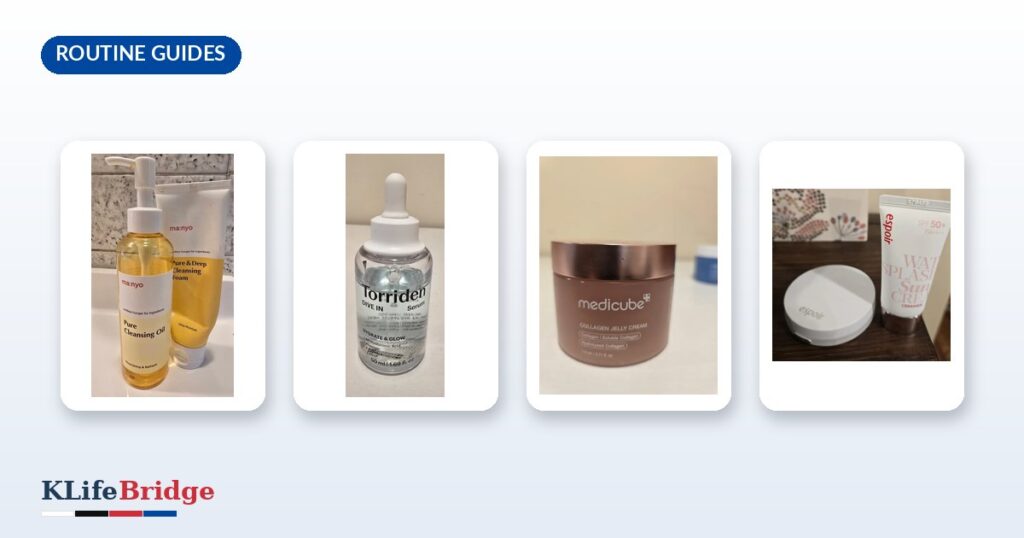
If you’ve ever searched “Korean skincare routine,” you’ve probably seen it: the famous 10-step routine, usually demonstrated by a woman in her twenties with skin like glass. Maybe you thought what I once did — that’s beautiful, but who has the time? And would any of it even work for my skin now?
Here’s what I want you to know, as a Korean American who grew up with these rituals and is now navigating midlife skin myself: most Korean women don’t do ten steps either. Especially not women our age. The 10-step routine was always more of a marketing story for export than a daily reality in Seoul. What Korean women over 40 actually practice is something quieter and much more sustainable — a short, consistent ritual built on one core idea: protect and nourish the skin barrier, gently, every single day.
My own wake-up call came during the pandemic. When COVID sent me home to work, I stopped paying attention to makeup and skincare almost entirely — and that same stretch of life happened to be when I crossed 50. About a year into working from home, I caught my reflection one day and really looked old: new wrinkles ringing my neck, and a scatter of dark spots across my cheeks that hadn’t been there before. Then I visited Korea and noticed something humbling — my friends and relatives there, some of them older than me, had healthy, glowing, clear skin. They weren’t doing anything extreme. They just had a routine, and they never skipped it.
This is the routine I researched, learned, tested on myself, and have recommended to every friend who’s asked where to start with K-beauty after 40. The before-and-after results made me a believer.
It takes just five steps, about ten minutes a day, and there’s no need to overcrowd your bathroom shelf with endless products.
Why Midlife Skin Needs a Different Routine
First, a quick honest look at what’s actually happening — because once you understand it, every step below makes sense.
From our early 40s onward, and especially through perimenopause and menopause, declining estrogen changes our skin in visible ways. Skin produces less oil, so it feels drier and “tighter” than it used to. Collagen — the protein that keeps skin firm — declines noticeably in the years around menopause, which shows up as fine lines, thinning, and a certain loss of bounce. The skin barrier (the outermost protective layer) becomes more fragile, which is why products you used for years may suddenly sting, and why dryness can come with itchiness.
None of this means our skin is “bad.” It means it has different needs: more hydration, more gentleness, and consistent protection — which happens to be exactly what Korean skincare philosophy has emphasized for generations. Where Western beauty culture often reaches for stronger and harsher (peels, acids, aggressive actives), the Korean instinct is to calm, layer hydration, and play the long game. For midlife skin, that instinct is a gift.
Step 1: The Gentle Cleanse (and Why You Should Stop Scrubbing)
Korean skincare treats cleansing as a cornerstone, not a throwaway step — but gentle is the operative word.
In the evening, use one gentle cleanser to remove the day — either an oil-based cleanser (a cleansing oil or balm massaged onto dry skin for a minute, which dissolves sunscreen and makeup beautifully) or a low-pH foaming or cream cleanser. For most days with light makeup and everyday sunscreen, one is genuinely enough — your skin should feel clean and comfortable, never tight or “squeaky,” which is the sound of a damaged barrier. You only need the two-step “double cleanse” (oil first, then a gentle wash) on heavy-makeup or thick, water-resistant-sunscreen days. In fact, over-washing does more harm to midlife skin than under-washing, so gentler and simpler usually wins.
In the morning? Most Korean women our age simply rinse with lukewarm water or use only a gentle cleanser. Your skin didn’t get dirty overnight, and preserving its natural oils is more valuable than another wash.
One rule above all: nothing that scrubs, foams aggressively, or leaves your face feeling “squeaky clean.” That feeling we were taught to chase in the 80s and 90s is the sound of your skin barrier crying.
Below is the one I am using: Round Lab 1025 DOKDO cleanser
Step 2: Hydrating Toner — Not the Kind You Remember
If the word “toner” makes you think of stinging astringents on a cotton ball, please meet the Korean version: a hydrating toner is essentially a first drink of water for your skin — a watery, soothing liquid patted on with clean hands right after cleansing, while skin is still slightly damp.
Why it matters after 40: dry skin absorbs the next products poorly. A hydrating toner preps the skin so everything that follows works better — think of it as moistening a dry sponge before asking it to soak anything up. Look for words like hydrating, soothing, balancing and ingredients like hyaluronic acid, glycerin, rice extract, or green tea. Avoid anything with a high alcohol content that lists “purifying” or “pore-tightening” as its main promise.
The Korean habit worth stealing: apply it within a minute of cleansing. Skin loses moisture rapidly right after washing, and this step catches it.
Step 3: The Treatment Layer — Essence or Serum, Chosen for Your Concern
Here’s where the routine becomes personal, and where all those mysterious K-beauty words — essence, serum, ampoule — live. Don’t be intimidated: they’re all versions of the same idea, a concentrated treatment layer, in different textures. (I’ve written a whole guide to the differences if you’re curious.)
For midlife skin, this is your one “active” step, and you only need to choose one lane to start:
For dullness and early wrinkles: a serum with snail mucin — yes, really, and I promise it’s elegant in practice — or peptides. Snail mucin is beloved in Korea for its ability to hydrate deeply and support skin repair, and it’s one of the gentlest “glow” ingredients for skin that has become reactive.
For dark spots and uneven tone: niacinamide or a gentle vitamin C formulated for sensitive skin. (One ordering tip if you choose a pure vitamin C serum for the morning: apply it first, on bare dry skin before your toner, and wait a minute — pure vitamin C works best at a low pH that bare-skin application protects. Gentle vitamin C derivatives don’t need this and can go after the toner. More in my vitamin C guide.)
For firmness: ginseng-based serums — Korea’s grandmother-approved answer to tired skin — or peptide formulas.
I’ll be honest with you about this step: it’s the overwhelming one. Even though I go to Korea every year, walking into an Olive Young or a pharmacy still floods me — walls and walls of serums, essences, and ampoules, all promising something. For years, if my daughter (who knows K-beauty inside and out) wasn’t shopping beside me, I would walk out having bought nothing at all. That paralysis is exactly why I started this site — so that you don’t need a K-beauty-fluent daughter on your arm to know where to begin.
Start with one. Use it consistently for six to eight weeks before judging. The Korean approach is patience over intensity — and at our age, our skin barrier will thank us for it.
Step 4: Moisturizer — Seal It All In
Everything you’ve layered so far is water-based, and water evaporates. The moisturizer’s job is to lock it in and reinforce the skin barrier with richer ingredients: ceramides, squalane, shea butter, or the classic Korean favorites like Centella asiatica (“cica”) for calming.
After 40, most of us need more than the gel-cream we used at 30. In the morning, a medium cream that sits well under sunscreen; at night, something richer — Korean “sleeping creams” or thicker barrier creams are wonderful here, because nighttime is when skin does its repair work. If you wake up with skin that feels comfortable rather than tight, your night cream is doing its job.
A small Korean technique that costs nothing: pat, don’t rub. Press the cream into your skin with your palms. It improves absorption and it’s gentler on skin that creases more easily than it used to — and honestly, those thirty seconds of pressing warm palms against your face are a small daily kindness. Korean skincare has always understood that the ritual itself is part of the benefit.
Step 5: Sunscreen — The Only True Anti-Aging Product
If you take one thing from this entire article, let it be this: daily sunscreen is the single most effective thing you can do for your skin after 40. Not the expensive serum, not the eye cream — sunscreen. The majority of what we call “aging” — dark spots, deepening wrinkles, sagging, crepey texture — is accumulated UV damage, and it continues through car windows and on cloudy days.
The reason so many women don’t wear it daily is that American drugstore sunscreens have historically been thick, white, and greasy. This is where K-beauty genuinely changes lives: Korean sunscreens are famous for feeling like light moisturizers — no white cast, no heaviness, lovely under makeup. Sun protection is so culturally ingrained in Korea that the formulas had to become pleasant enough to wear every single day, and they did.
Apply it every morning as your final step, rain or shine, roughly a nickel-sized amount for the face, and bring it down your neck — the neck shows sun damage first (that’s a whole article of its own).
I learned this one the hard way — those dark spots I discovered on my cheeks after a year of “I’m just working from home, why bother” were partly the result of skipping sunscreen indoors. UVA rays pass through windows. Home office by the window, bare face, one year: spots. Don’t be me.
Your 10-Minute Daily Rhythm, Summarized
Morning: rinse or gentle cleanse → hydrating toner → serum (if using one in the AM) → moisturizer → sunscreen. About five minutes.
Evening: oil cleanse → gentle cleanse → hydrating toner → treatment serum → night cream. About five to seven minutes, and honestly the most pleasant part of my day.
That’s the real Korean routine for skin over 40 — not ten steps, but five thoughtful ones, done with consistency and a little tenderness toward skin that has carried you this far. Start simple, be patient, and let the ritual become something you look forward to rather than a chore.
If you’re wondering which specific products to begin with, my beginner’s guide to your first seven K-beauty products picks affordable, gentle options for every step above. And if sudden dryness is your main battle, the article on menopause and your skin barrier explains what’s happening underneath and how to fix it.
Related Reads on KLifeBridge
If this was helpful, you may also like:
- Your First 7 K-Beauty Products Over 40
- How to Layer Korean Skincare: The Right Order
- Vitamin C for Mature Skin: Which Form Won’t Irritate
- Your Evening Routine, the Korean Way
Sources & further reading
The science behind why midlife skin needs gentler, more hydrating care:
- Lephart ED, Naftolin F. Menopause and the Skin: Cosmeceuticals for Estrogen-Deficient Skin. Dermatol Ther (Heidelb), 2020 — on how declining estrogen reduces collagen, oil, and barrier strength. view study
- American Academy of Dermatology — Caring for your skin in menopause. aad.org
This article is for general information only and isn’t medical advice. For persistent skin concerns, please see a dermatologist or your doctor.
This article is for general information only and isn’t medical advice. For persistent skin concerns, please see a